Spatial Transcriptomics (Visium)
Spatial transcriptomics enables the study of gene expression in intact tissue sections while preserving spatial information. This technology combines histological context with transcriptome-wide profiling, allowing researchers to map cell types, states, and interactions directly onto tissue architecture.
At NGI we provide support for several spatial transcriptomics approaches, primarily based on the 10x Genomics Visium platforms. These methods allow you to capture polyadenylated RNAs from fresh frozen tissues and use probes covering the whole transcriptome on FFPE tissues to generate high-resolution maps of gene activity. Our service includes guidance on sample preparation, library construction, sequencing, and basic downstream analysis.
Explore our current spatial transcriptomics applications below to find the approach that best suits your project. Please feel free to contact us contact us for advice on experimental design, tissue requirements, or other questions.
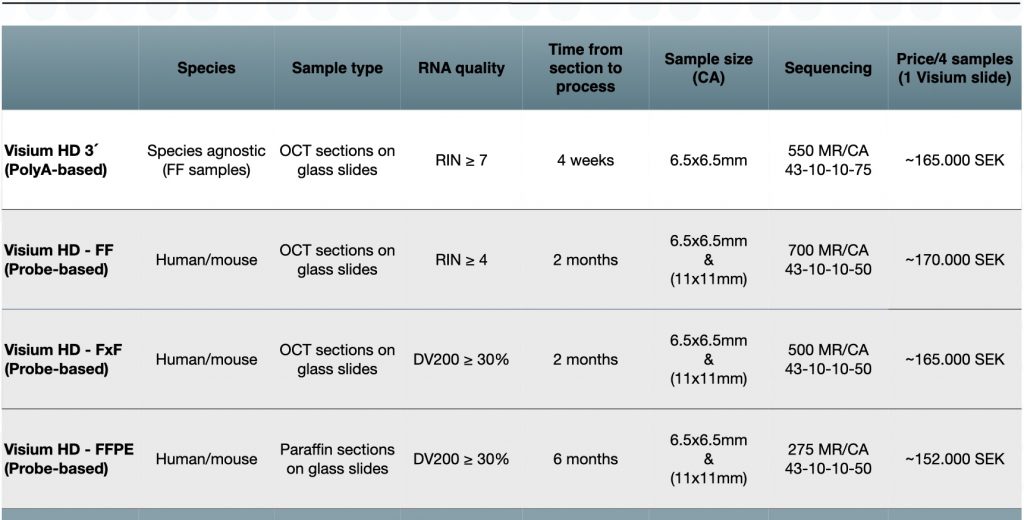
Price examples
The basic cost to perform a Visium HD experiment on four 6x6mm tissue samples (including staining, imaging, library prep, sequencing and running SpaceRanger) is around 165.000 SEK. However, the price depends on the method and the sequencing depth required.
Last Updated: 9th June 2026